
CYBERSECURITY FOR CONNECTED INDUSTRIAL IT, PLANNED AHEAD |
New EU requirements are placing a stronger focus on secure communication, updates and lifecycle support. |
|
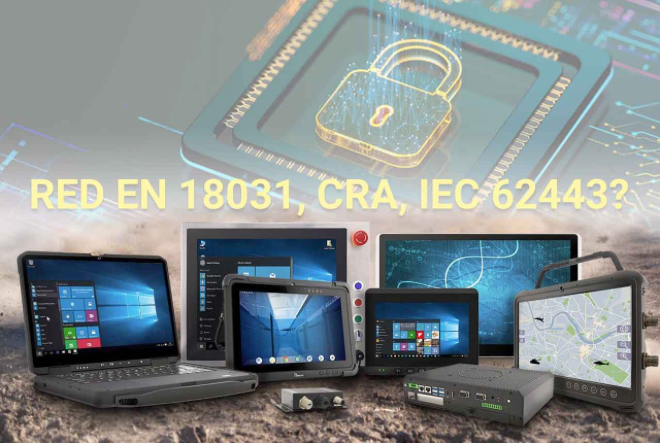
Connected industrial hardware is now standard in many applications – from industrial tablets and panel PCs to embedded systems with Wi-Fi, Bluetooth, LTE/5G or other interfaces. With RED EN 18031 and the Cyber Resilience Act, cybersecurity requirements are gaining additional importance. The focus is not only on individual technical protection mechanisms, but increasingly also on secure development, updates, documentation and vulnerability management. For companies using long-term hardware platforms in machines, plants, mobile applications or IoT environments, cybersecurity is therefore becoming an important factor in project planning. |
||||||||||
![[Graphic] CRA Phases 2024-2027](https://files.crsend.com/225000/225105/images/fml/aafa8a5d-2311-4894-b60b-d3fb101007dd/img-x-det-1.png) |
||||||||||
|
For a compact introduction to the key terms and interrelationships, we have summarized the main points for you: |
||||||||||
| Cybersecurity overview | ||||||||||
|
Why the topic is relevant now |
||||||||||
|
Connected devices communicate with networks, machines, backend systems or cloud environments. As a result, access protection, secure communication, update capability and documentation need to be considered as early as the selection of suitable hardware. RED, CRA and IEC 62443 briefly explained RED EN 18031 focuses on cybersecurity requirements for certain radio-enabled products, including the protection of networks, data and protection against misuse. |
||||||||||
![[Graphic] RED EN 18031 Details](https://files.crsend.com/225000/225105/images/fml/085a30ae-d50d-4250-a47c-b06ac8300f96/img-x-det-2.png) |
||||||||||
|
The Cyber Resilience Act (CRA) expands the perspective to products with digital elements and their development, maintenance, vulnerability management and supply chain. |
||||||||||
![[Graphic] Cyber Resilience Act Details](https://files.crsend.com/225000/225105/images/fml/77f34755-96c4-4843-b0fd-dd15307780bf/img-x-det-3.png) |
||||||||||
|
IEC 62443 serves as an important orientation framework in industry for structured cybersecurity processes – particularly in industrial automation and control systems. |
||||||||||
|
What does this mean for your projects and hardware selection? |
||||||||||
|
For industrial hardware, robustness, long-term availability, interfaces, performance and mechanical integration remain important. At the same time, additional questions are becoming more relevant:
|
||||||||||
|
Relevant background information and a compact classification of the most important cybersecurity requirements can be found in our overview: |
||||||||||
| Cybersecurity overview | ||||||||||
|
Conclusion: Cybersecurity is increasingly becoming an important factor for long-term viable projects involving connected industrial hardware – from secure interfaces and update capability to documentation throughout the product lifecycle. TL Electronic supports you in evaluating suitable systems at an early stage and selecting appropriate hardware solutions for your application. We would be pleased to advise you personally on your specific application. |
||||||||||
| Contact your expert now | ||||||||||
 Cristian Gagliolo Sales Manager, TL Electronic |